Key Takeaways
- Quarantine first, argue later. The first action after a failed inspection is physical: segregate the batch so it cannot enter use while the discrepancy is evaluated. Segregation is one of the core controls for nonconforming product in ISO 13485:2016, the quality management standard that the US FDA’s Quality Management System Regulation, effective 2 February 2026, now incorporates by reference.
- Your written specification is your case. A discrepancy can only be measured against something written down. Where the order said “medical-grade coveralls”, there is often very little to measure against.
- Notify formally, not just by phone. A written notice that references the purchase order, the specification and the evidence gives both sides the same facts and a clear starting point.
- Sampling decisions need a defined plan. Lot acceptance by attributes is commonly run against a sampling scheme such as ISO 2859-1, indexed by acceptance quality limit (AQL). Agree the plan before delivery, not after a failure.
When a shipment of disposable protective clothing fails incoming inspection, the response follows five steps: quarantine the batch, document the discrepancy against your written specification, notify the supplier formally, agree a resolution path, and confirm that resolution in writing before anything moves further into your facility. A failed inspection feels like a crisis on the day it happens. In practice it is a well-defined process, and the buyers who handle it well are usually the ones who knew the steps before the truck arrived.
Without a plan, buyers tend to fall into one of two traps. Some escalate immediately, turning a fixable batch problem into a strained supplier relationship. Others accept a compromised batch quietly because production needs the garments this week and the paperwork feels like more trouble than the defect. Neither protects the people who will wear the garments, and neither stops the same thing happening on the next order.
This guide is for QA heads, receiving teams and procurement managers buying disposable protective clothing in bulk, written from the manufacturer’s side of the table. Dispowear Protection, part of the Mewar Polytex Group and manufacturing disposable protective clothing since 2005, produces over 3 million disposable garments every month from its own GenFab® nonwoven fabric across two plants, serving hospitals, pharmaceutical companies and distributors across India and international markets.
Physical control first, evidence second, negotiation third. Reversing that order is how a fixable batch problem becomes a dispute.
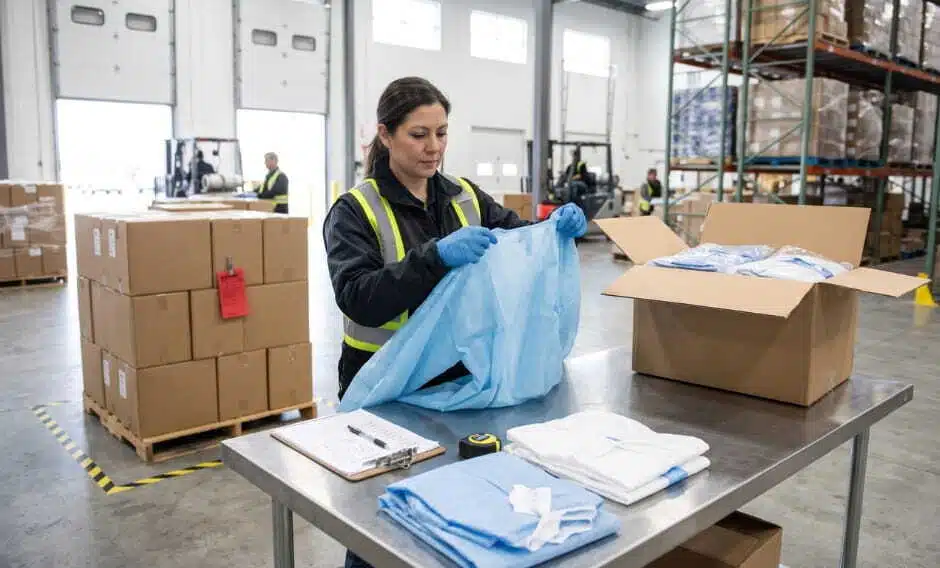
The first action after a failed PPE shipment inspection is physical, not administrative. Move the affected cartons to a clearly marked hold area, label them as quarantined or on hold, and make sure your stores system cannot issue them while the question is open. Do this before you call anyone.
The reason is practical. Disposable protective clothing moves quickly from a receiving bay to a gowning room or a ward store, and once garments from a questionable batch are mixed with compliant stock, two things are lost. You lose the ability to say which garments are affected, and you lose the option of partial acceptance, because nobody can sort what has already been distributed. A batch that fails on one criterion, such as carton labelling or a minority of mis-sized units, may still be largely usable after sorting. That option only exists while the batch is intact.
ISO 13485:2016 includes requirements for identifying, documenting, segregating and controlling nonconforming products within a manufacturer’s quality management system. Buyers can apply similar segregation and documentation principles during incoming inspection to prevent potentially nonconforming garments from entering use.
The strength of your position depends almost entirely on having a written specification to measure against. If the purchase order says “white SBPP coverall, 40 GSM nominal, sizes M to XXL in the agreed ratio, elastic hood, wrist and ankle, zip front with storm flap”, a discrepancy is a measurable fact. If it says “disposable coveralls, good quality”, you are about to negotiate opinions. This is the point at which a vague order or tender document becomes a real problem, which is why the guide to having a written specification to measure against is the natural companion to this one.
Record the evidence while the batch is in quarantine and before anyone else handles it.
Suppliers that provide a certificate of analysis, GSM data and fabric test reports with each lot give you a second reference point. Comparing your measurement with the supplier’s own lot documentation often shows quickly whether the problem is a fabric deviation, a conversion error, a labelling mix-up or damage in transit. For a fuller view of what quality documentation should look like, see what auditors expect from documentation, and for the receiving checks themselves, the incoming quality checks in the hospital PPE checklist.
A phone call is a good way to give a supplier early warning. It is not a notification. Follow it the same day with a written notice, because a documented notice gives both parties the same facts, starts any response period your contract defines, and protects your position if the matter later needs to be escalated.
A useful formal notice includes:
Keep the tone factual: a precise notice that asks for a proposed resolution usually gets a faster answer than one that opens with penalties. Your contract terms and your organisation’s procurement or legal policy govern what notices are required and within what period, so check those before relying on any generic sequence, including this one.
Most failed inspections end in one of three resolution paths, and the right one depends on the nature of the defect, how urgently the garments are needed and how much of the lot is affected.
| Resolution path | When it usually fits | What to agree in writing | Watch for |
|---|---|---|---|
| Full replacement | The defect affects the whole lot or a critical requirement (wrong fabric, wrong GSM, barrier or sterility documentation missing) | Replacement quantity, delivery date, collection or disposal of the rejected lot, and re-inspection of the replacement | A gap in supply while the replacement is produced; agree whether interim stock is available |
| Sorting with partial acceptance | A defined minority of units are affected (mis-sized units, isolated seam defects, damaged cartons) and the rest meet specification | Who sorts, against what criteria, at whose cost, and how rejected units are replaced or credited | Sorting criteria that are vague; accepted units must be traceable to the original lot |
| Rejection with credit or refund | The garments are not usable and a replacement is not wanted or cannot arrive in time | Credit amount, return or disposal arrangements, and how the shortfall will be covered | You still have to source the quantity elsewhere, often at short notice |
Resolution paths reflect common commercial practice and the identification, segregation and disposition controls for nonconforming product in ISO 13485:2016. Indicative only; your purchase contract and procurement policy decide the actual remedies available.
One option sits outside this table: accepting a nonconforming batch under an approved concession or deviation. This may be considered only when the discrepancy has been assessed and confirmed not to compromise product safety, performance, regulatory requirements or intended use. The decision should be documented and approved by the authorised quality representative. It should never become an informal workaround because stock is running low.
From the manufacturer’s side, a responsible resolution process looks broadly the same whoever the supplier is. The supplier traces the lot back through production records to the fabric roll and production line, checks retained samples, identifies whether the cause is isolated or systemic, and proposes a remedy that matches the evidence. Dispowear’s lot traceability, from GenFab® fabric roll to finished carton, is designed to make that trace possible, and the resolution itself is agreed case by case according to the order, the defect and the contract. Treat any supplier that cannot trace a lot back to its production records as a supplier that will struggle to tell you why a batch failed.
A failed inspection is not closed when the replacement arrives. It is closed when you know why it happened and what changes because of it. Ask the supplier for a short written root-cause explanation and the corrective action taken, then look at your own side of the process with the same honesty.
Record the outcome in your supplier performance file; one well-handled nonconformance can tell you more about a supplier’s quality system than a year of clean deliveries. Before your next order, the questions to ask before you order are a good place to check that documentation, traceability and sampling are all agreed up front.
These are the parameters that most often appear in an incoming inspection of disposable protective clothing. Fixing each of them on the order makes a failed inspection measurable rather than arguable.
| Parameter | Typical specification |
|---|---|
| Fabric | GenFab® virgin-polypropylene SBPP nonwoven, manufactured in-house; SMS and laminated constructions available |
| GSM | Selected according to application requirements, stated on the order datasheet and supported by lot GSM data |
| Garment and construction | Coveralls, gowns, lab coats, aprons, sleeve covers, head coverings, shoe and boot covers; closure, elastication and seam type fixed per order |
| Sizing | Size chart and size ratio agreed per order, so cartons can be checked against a defined mix |
| Barrier and treatments | Lamination and anti-static treatment selected according to application requirements; performance confirmed through technical documentation where applicable |
| Sterility | Non-sterile as standard; gamma-sterilised options for applicable products, with dose, packaging and documentation confirmed according to the specific product and order |
| Colour and branding | White, blue, green and custom shades; private label and custom printing available |
| Packaging and labelling | Units per inner pack and per carton, carton marking and lot number placement agreed per order |
| Documentation | COA, GSM data, fabric test reports and lot traceability supplied with each batch |
Figures are indicative and confirmed on the product datasheet for each order. Certification status for any specific classification is confirmed on that product’s own technical documentation.
The full procurement playbook shows where inspection fits alongside forecasting, specification, inventory and cost.
A failed incoming inspection is a process problem with a known shape, not a crisis. Quarantine the affected lot before anyone touches it, measure the discrepancy against a written specification, notify formally with evidence attached, choose the resolution path the evidence supports, and close the loop with a root cause on both sides. The work that makes all five steps easier happens earlier: a precise specification, an agreed sampling plan and a supplier whose lot documentation lets a batch be traced from fabric to carton. Put those in place before the next delivery and the next failed inspection, if it comes, will take days rather than weeks to resolve.
Want to discuss batch traceability, lot documentation and quality assurance on bulk orders? Request a bulk quotation, technical specification sheet or product samples, and talk to the team about how GenFab® lot documentation supports your incoming inspection.
Quarantine the affected lot so it cannot be issued, document the discrepancy against your written specification with lot numbers, photographs and measurements, then notify the supplier formally in writing. Agree a resolution path, which is usually replacement, sorting with partial acceptance, or rejection with credit, and confirm it in writing. Finally, ask for a root-cause explanation and review your own specification and sampling plan.
Generally, a buyer can reject goods that do not conform to the agreed specification, but the exact rights, notice periods and remedies depend on your purchase contract and applicable law. Your position is strongest when the specification was written precisely, the sampling plan was agreed in advance and the discrepancy is documented. Check your contract and your organisation’s procurement or legal policy before issuing a formal rejection.
Keep the purchase order and specification, the delivery note and invoice, lot or batch numbers, the sampling plan used, the inspection record with measurements, and dated photographs of labels, defects and carton condition. Retain physical samples of both failed and passing units. The supplier’s certificate of analysis and lot test reports are a useful comparison point when you investigate the cause together.
Start from shared evidence rather than positions. Share your inspection record and samples, ask the supplier to trace the lot through its production records, and agree the cause before discussing the remedy. If that does not resolve it, escalate through the route defined in your contract.
It can make sense when the defect is limited to an identifiable minority of units and the rest fully meet specification. Agree in writing who sorts the lot, against what criteria, and how the rejected units will be replaced or credited, and keep accepted units traceable to the original lot. If the defect could affect protection and cannot be reliably identified unit by unit, sorting is not a safe option.

Sandeep Bapna is a commerce graduate. In 1993, he received an MBA with a finance concentration from Mumbai’s Narsee Monjee Institute of Management Studies, following his B.Com. (Hons). Following that, he began working for his father’s company, Mewar Polytex Ltd. He has played a vital role in developing the group’s business from Rs. 3 crores in 1993 to Rs. 650 crores in 2022. He was instrumental in the formation of Anita Plastics, Inc., a distribution company in the United States. He led the team that established Harmony Plastics P. Ltd. in 2005 to produce construction fabrics in collaboration with Alpha ProTech of the United States. He has also served in a leadership role on Rajasthan’s Plastics Export Committee. He serves as the Managing Director of Mewar Polytex Group.
Read More